
Understanding landlord roof repair responsibilities Oklahoma property owners may face starts with two practical priorities: protecting people and responding thoughtfully when a roof problem threatens the rental. A small interior stain does not always reveal the full extent or source of moisture. Landlords can use a consistent process to receive reports, identify immediate hazards, arrange an appropriate assessment, keep tenants informed, and preserve records. The lease and facts of a particular situation matter, so this guide offers general property-management information, not legal advice.
Call to ask about a free roof inspection
What should landlords understand about roof repair responsibilities?
Roof repair responsibilities are not determined by a stain alone. A landlord should consider the lease, the condition reported, the circumstances that caused it, applicable law, and what a qualified inspection finds. A tenant’s actions may be relevant in a specific dispute, but a landlord should not assume blame from the first report or ask a resident to diagnose a roof assembly. The immediate property-management task is to establish what is happening and what action is needed to protect occupants and limit additional damage.
Oklahoma’s Residential Landlord and Tenant Act addresses duties related to maintaining a dwelling. The details can depend on the lease and situation. The Oklahoma Residential Landlord and Tenant Act overview is a useful starting point for general orientation, not a decision about a particular dispute. If there is disagreement about required repairs, notice, access, rent, or habitability, consult a qualified Oklahoma attorney or tenant resource instead of relying on a contractor’s observations as a legal conclusion.
For day-to-day operations, the owner or manager benefits from having a clear route for reports. Tenants should know where to send a maintenance concern, what information is useful, and how to report an urgent safety issue. The person receiving the report should know who can approve an inspection or work, who communicates with the tenant, and where records are kept. A simple process helps a landlord respond consistently even when the roof is not the only maintenance issue being managed.
It is helpful to separate three questions that are often blended together: Is anyone in immediate danger? Is water actively entering or likely to continue? What assessment or repair does the building need? The first question may call for safety measures before a roofer can inspect. The second helps the owner decide how quickly to coordinate a visit or temporary protection. The third should be informed by the roof’s observed condition and a written scope, not just a guess based on an interior mark.
What should a landlord do first when a tenant reports a leak?
Start by acknowledging the report and collecting enough information to sort urgency from routine follow-up. Do not leave a tenant wondering whether the message was received. Ask where the water is visible, when it started, whether it is still entering, and whether it is near an electrical fixture or accompanied by a sagging ceiling. Request a photo only if it can be taken safely from the floor or another ordinary vantage point. No resident should be asked to climb onto the roof, use a ladder, touch wiring, or enter a potentially unsafe attic to help with diagnosis.
- Confirm receipt. Record when the tenant contacted you and reply in a direct, respectful way. A short acknowledgment gives the tenant a clear next step and starts a reliable record.
- Check for immediate hazards. Ask about active dripping, water near lights or outlets, a ceiling that is sagging or soft, slippery floors, or another visible danger. If there is an immediate threat, direct occupants away from the area and contact the appropriate emergency service or qualified professional.
- Suggest safe, limited protection. If it is safe, the tenant may move belongings away from a drip or place a container under it. Do not ask the tenant to perform roof work, climb to a ceiling, or handle a fixture that may be wet.
- Arrange a professional assessment. Share the basic facts and access details with a qualified roofing professional. Ask for findings that identify the observed condition and proposed next steps.
- Set a follow-up point. Tell the tenant what you are doing next and how to report a change, without promising an arrival or completion time that has not been confirmed.
Consider two reports that arrive on the same rainy day. One tenant notices a dry, dime-sized ceiling discoloration that has not changed since the previous storm. Another reports a steady drip near a light fixture. Both reports deserve attention, but the immediate safety question is different. The first may require documentation and an arranged inspection; the second calls for immediate direction to avoid the affected area and a prompt assessment of the hazard. A repeatable intake process helps managers distinguish these facts without minimizing either report.
Do not tell a tenant that a problem is harmless based on a brief description. A small stain may be old, but it may also be a new sign of moisture that has spread inside a roof or wall assembly. Conversely, the mark may not have originated at the roof. Record what is known as an observation and keep a separate place for what still needs professional evaluation.
How can landlords triage a leak without trying to diagnose it?
Triage is information gathering, not a substitute for inspection. Its purpose is to identify urgent safety concerns, preserve useful observations, and help the right person understand what to assess. Ask the same short questions for each report so that details are not lost in a sequence of hurried calls and messages. It is also useful to distinguish the tenant’s direct observation from a conclusion someone has reached about the cause.
- Location: Which room, floor, ceiling or wall area is affected? Are there several spots, and are they close together or in different parts of the building?
- Timing: When did the tenant first notice the condition? Did it follow rain or wind, appear after plumbing use, or recur after an earlier repair?
- Current status: Is there active dripping, a damp surface, or only a stain that is no longer changing? Has the tenant seen the condition worsen?
- Safety: Is water near electrical equipment? Is a ceiling sagging, a floor slippery, or a path blocked? Has anyone been asked to enter an attic or climb a ladder?
- Impact: Are belongings, a room, or a shared space affected? Has anyone moved items or placed a container, and can that be done safely?
- History: Has the same place leaked before? Was any roof or interior work recently completed? Are there prior photos or contractor records?
These questions help the owner communicate accurately without turning a tenant into an inspector. Do not ask an occupant to decide whether shingles, flashing, vents, a membrane, or a roof edge has failed. A person looking up from inside cannot reliably trace a path through roof materials and framing. Water may travel before it appears indoors, so the ceiling mark may not sit directly below the entry point. Even a photo that looks clear does not necessarily show the cause.
For example, a tenant might report that a bedroom stain appeared after wind-driven rain and has grown over two days. The manager can record those words, ask whether the area is wet now, request a safe photo, and pass along the history. The manager should not label the condition “a shingle leak” unless an assessment supports that description. In a different case, a tenant may report a recurring bathroom stain without a connection to recent rain. That history still matters, but the assessment should remain open to other possible sources rather than presuming the roof is responsible.
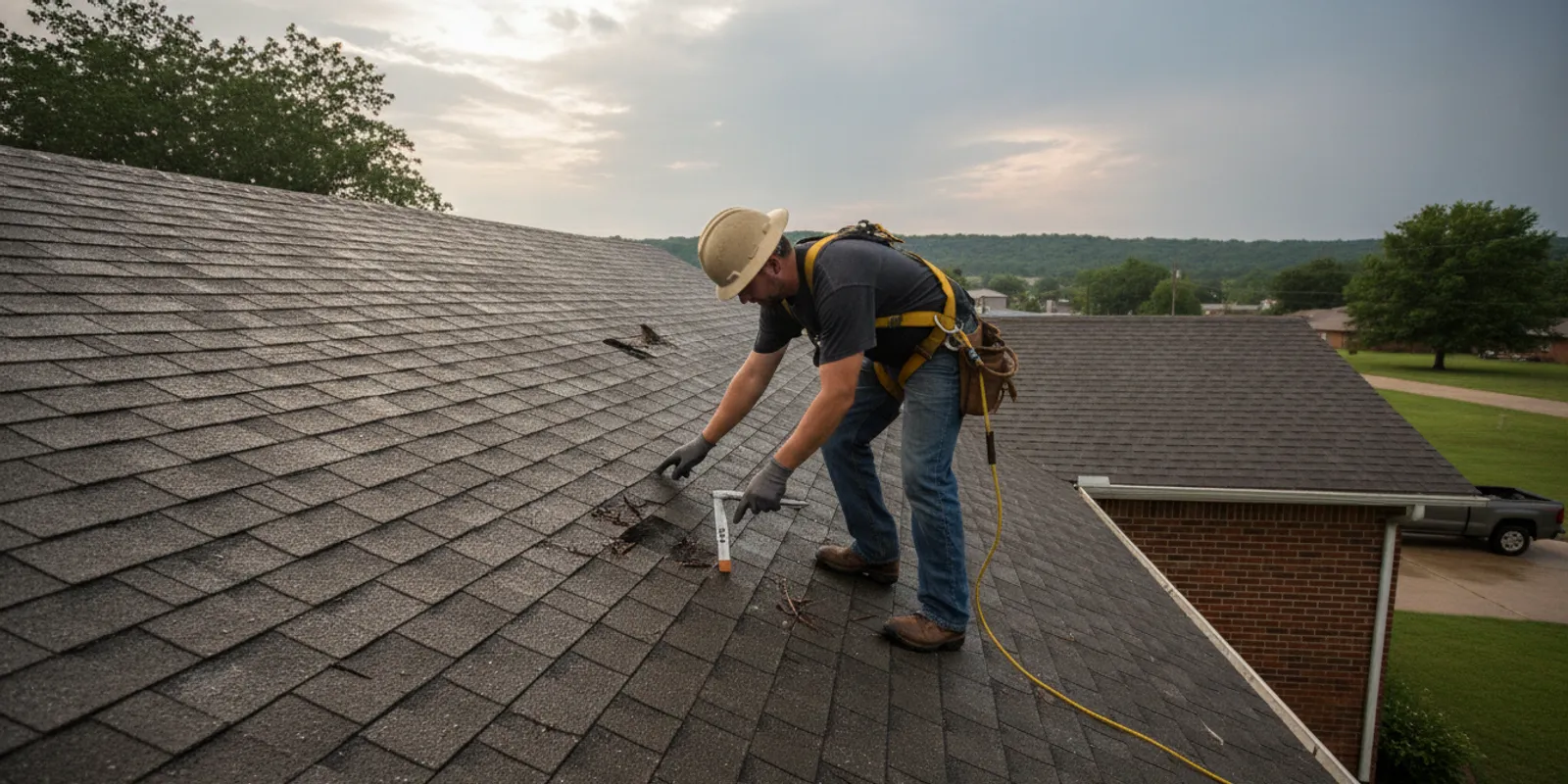
Do not use a roof walk as a shortcut to triage. Wet, steep, damaged, or unfamiliar roofs can be hazardous, and ground-level views do not reveal every condition. Property owners should arrange suitable professional access instead of asking tenants, maintenance staff without appropriate qualifications, or an unprepared owner to climb up. A safe process protects people while still moving the investigation forward.
How should a landlord document roof damage?
A consistent incident record supports decisions, helps the owner follow the sequence of events, and makes it easier to determine whether a repair addressed the reported issue. Create a separate record for each incident, even when the same property has a longer maintenance history. Begin with the date and time the report was received, the unit or area, the person who reported it, and a factual summary of what that person observed. If the exact start time is unknown, write that it is unknown instead of filling in a guess.
Store records in a single property file or maintenance system rather than leaving pieces across individual inboxes. A useful sequence is: initial report, follow-up questions, safe photos, any safety direction, inspection findings, scope or proposal, approval, work records, invoices, and post-repair follow-up. Give files descriptive names, such as “2026-10-30-unit-2-bedroom-ceiling,” so they can be found later. Keep records secure and share tenant information only with people who need it for assessment, coordination, or an authorized decision.
- Keep the original tenant message, including its date and time, and note the channel through which it arrived.
- Save interior photos showing the affected area from a safe position. If the tenant sends an image, retain the original and note who supplied it.
- Record visible exterior observations only from a safe ground-level or otherwise suitable vantage point; do not treat them as a complete roof inspection.
- Keep the written inspection findings, proposal, approved scope, work documentation, and invoice together.
- Note who spoke with the tenant, who authorized work, and when the tenant was asked to report whether the leak continued.
- Preserve any insurance communications separately but cross-reference them to the same incident record.
Use neutral language. “Tenant reports water dripping near the east bedroom light during rain” is more useful than “roof failed because tenant left window open,” unless that cause has actually been established. The log can include a clearly marked section for observations, one for assessments, and one for decisions. That separation helps a future reader understand which facts came from the tenant, which came from a roofer, and which reflect the landlord’s response.
Documentation is not an effort to build a case against a tenant or contractor. It is a practical record of what was reported, what was inspected, what work was authorized, and what happened afterward. If a tenant reports that the same spot is wet again, attach that message to the original incident and record whether a new assessment was arranged. A repeated symptom after work is useful information; it should not be dismissed merely because an invoice says a repair was completed.
What makes a useful roof inspection record?
A useful inspection record explains what the professional was asked to examine and what was observed. Before the visit, provide the report date, affected room or unit, known prior work, and any relevant access restrictions. If the tenant has multiple affected areas, list each one rather than saying only “leak in the building.” For a multi-unit property, a simple floor plan or unit list may help connect reports to locations, as long as it does not substitute for the inspection.
After the assessment, read the findings for location, observed condition, recommended work, and any limits. Ask the professional to distinguish what was seen from what is suspected or concealed. If a source cannot be confirmed during the visit, ask what additional inspection would help resolve the uncertainty and whether any temporary measure is advisable. A clear answer may be that more access or a later review is needed; do not convert an uncertain finding into a definite cause when sharing it with a tenant or insurer.
Photos can make a written report easier to understand when they are labeled and tied to locations. Ask what a photo shows, where it was taken, and whether it depicts the condition before or after work. An unlabeled image of a roof surface may be difficult to connect to a particular unit or leak. If an inspection includes only a limited area or visual review, retain that limitation with the findings. Do not describe a limited check as a comprehensive evaluation if it was not one.
The property owner should also keep the request and findings together. If the original request asked about a ceiling stain in one room but the contractor evaluated a different roof area, note why. If the written findings recommend follow-up that has not yet occurred, list it as an open item. A concise inspection record is valuable because it helps the next person continue from the actual evidence rather than starting over with an incomplete summary.
For a storm-related concern, dated observations and photos may help explain the condition being discussed with an insurer. They do not establish coverage, prove a particular cause by themselves, or guarantee claim approval. A roofing professional can document observed conditions and provide an inspection report; an insurer makes coverage decisions under the applicable policy. See this guide to roof documentation and insurance discussions for related homeowner considerations.
How can landlords communicate clearly while repairs are pending?
Tenants need accurate updates, not unsupported certainty. In each message, state what is known, what remains under review, and what the next step is. For example: “I received your report about the bedroom ceiling. Please avoid the area if water is near the light. I am arranging a roof assessment and will update you when I have confirmed the next details.” This says what is happening without guessing at the source or guaranteeing an appointment time.
It can help to divide communication into four points. First, confirm receipt and identify any immediate safety action. Second, explain that an assessment or temporary protection is being arranged. Third, once findings are available, summarize the proposed work and any access needs in plain language. Fourth, after work, ask whether the reported symptom has returned. These updates are not a legal notice template; use the lease and appropriate legal guidance for formal notices, access requirements, or disputes.
Before work is approved, explain practical details when known: which room or exterior area may be affected, whether someone needs to provide access, and what belongings may need to be moved away from the work area. Do not promise that the work will be quiet, take a certain number of hours, or be finished by a particular date unless the information is confirmed and appropriate to share. Weather, concealed conditions, materials, access, and scope can affect work. Give tenants updates when a confirmed detail changes rather than letting them infer that silence means the issue was forgotten.
Keep the tone factual and respectful. Avoid dismissive replies such as “it is probably nothing,” and avoid blaming a tenant before there is evidence. If the tenant says the leak has worsened, record the update and revisit urgency. If the tenant disagrees with a proposed repair or asks about legal rights, acknowledge the concern and seek qualified advice rather than arguing from a contractor’s report. A manager can explain what has been observed without presenting an interpretation as a legal ruling.
One useful operating practice is to identify a single contact for the incident. The tenant then knows where to send updates, and the roofer or property manager knows who can answer access and scope questions. If several staff members are involved, keep the shared record current so that one person does not tell the tenant an inspection is pending while another assumes it already happened. Clear ownership of the next action prevents avoidable gaps.
How should landlords evaluate a roof repair proposal?
A proposal is easier to evaluate when it explains the condition, location, and work in terms a property owner can understand. Ask what was observed and how it relates to the reported leak. The proposed work should identify the area being addressed and the components included, not just use a broad label such as “roof repair.” If a contractor recommends a targeted patch, ask why that scope matches the observed condition. If a more extensive repair is recommended, ask what evidence supports the wider scope.
- Finding: What was observed, where was it found, and what is confirmed versus uncertain?
- Work included: Which materials or components will be removed, repaired, sealed, or replaced?
- Work excluded: Does the proposal exclude interior finishes, concealed damage, or adjacent roof areas?
- Access and protection: What access is needed, and what should the owner or tenant move or protect?
- Changes: How will newly discovered conditions be documented, and who must approve added work?
- Closeout: What photos, notes, invoice, or other records will the property owner receive?
Ask for unfamiliar terms to be explained in plain language and, when helpful, marked on a photo or diagram. A proposal may use technical descriptions that are accurate but difficult to compare without context. It is reasonable to ask whether the scope targets the reported symptom, what the professional expects the work to address, and what would call for a separate follow-up. Do not assume that the least extensive proposal is automatically sufficient or that the broadest proposal is automatically necessary.
Compare proposals by scope, not just by the amount due. One may cover a small localized repair while another includes adjacent materials or a more extensive investigation. Those are not equivalent choices unless they address the same issue and include similar work. If proposals differ, ask each provider to clarify the exact area and components included. A written explanation helps an owner make an informed decision and gives the tenant a more accurate account of what is planned.
Where a proposal includes a written warranty or other assurance, read the actual terms. Ask what work is covered, for how long, what conditions or exclusions apply, and how to report a concern. Do not infer broad coverage from a short verbal statement. Keep the written terms with the job record and avoid telling a tenant that an issue is covered until the agreement and circumstances have been reviewed.
When does a localized repair need a broader evaluation?
A single leak report does not automatically call for roof replacement, and a small interior stain does not automatically mean a small repair will solve the problem. The right scope depends on the condition observed, roof design, prior repairs, extent of damage, and the professional’s assessment. A focused repair may fit a localized issue. Recurring water intrusion, multiple affected areas, widespread visible deterioration, or storm-related concerns across different roof areas may warrant a broader evaluation. The owner should base that decision on documented findings, not on the stain’s size alone.
Consider a hypothetical rental home with one leak near a roof penetration and no history of other trouble. A professional might find a limited condition and propose targeted work. The landlord can ask how the finding was identified, what part of the assembly is included, and how the work will be checked. The owner should still schedule a follow-up with the tenant after the work to learn whether the symptom recurs. A localized scope can be appropriate, but the record should make clear what it did and did not cover.
Now consider a different property where three units report separate ceiling stains after a storm, and prior repair records show leaks in more than one area. A single interior patch might not answer whether the conditions share a cause. The manager can provide the complete report map, past findings, and repair history to the assessor and ask whether a broader roof review is warranted. The findings may still support several separate repairs, but the professional should have the context needed to assess patterns instead of looking at only one symptom.
For a replacement discussion, ask what the inspection found across the roof, which components may be affected, what repair alternatives were considered, and what the options leave unresolved. The owner can also ask for a clear scope and a property-specific estimate rather than relying on a general article or a neighbor’s project. This overview of roof replacement considerations in Oklahoma City offers context for questions, but it cannot establish the cost or scope for a specific rental property.
Keep the decision process separate from assumptions about a tenant’s lease or insurance. A recommendation for broader roof work does not itself settle who is legally responsible for every associated cost, and an insurance inquiry does not determine what work the building needs. For those questions, rely on the relevant agreement, policy, documented findings, and professional advice appropriate to the issue.
What records should landlords keep when insurance may be involved?
Insurance policies differ, so the property owner should review the applicable policy and contact the insurer about notice requirements, documentation, and coverage questions. Keep the roof professional’s observations separate from an insurer’s decision. A contractor may inspect and document visible conditions, but does not decide what the policy covers. No inspection report or photo set guarantees claim approval or a particular payment.
Maintain a timeline with the date the condition was first reported, any dates the owner contacted the insurer, inspection dates, instructions received, and the dates of temporary or permanent work. Save claim reference details and the names or roles of people contacted when appropriate. Preserve the original photos, written inspection findings, proposals, invoices, and communications. If the insurer asks for specific material, provide it through the insurer’s process and keep a copy in the property file.
Do not assume that a claim decision should come before basic safety action. If water is actively entering or occupants could be at risk, address the immediate concern and ask the insurer how to handle temporary measures and records. Keep receipts and note what work was done and why. Avoid authorizing work on the assumption that it will be reimbursed; coverage and reimbursement depend on the policy and insurer’s review.
If a tenant’s personal belongings are affected, record what the tenant reports and refer personal-property coverage questions to the tenant’s own insurer or qualified adviser. The owner’s building policy and a tenant’s personal-property coverage are different matters. Do not promise to pay for belongings or tell the tenant that a policy will respond without a basis for that statement. The landlord can communicate what is known about the building repair while directing coverage questions to the appropriate source.
When sharing documents, distinguish between what the roofer observed and what the owner believes caused the damage. A concise factual chronology can help the insurer understand the sequence without making a coverage argument on behalf of the contractor. If the situation involves a dispute about the policy, consult the insurer and an appropriate qualified adviser. Keep the property maintenance file complete regardless of the claim outcome, because the owner still needs to know what work was completed and whether the reported leak returned.
What warning signs deserve prompt attention?
Some observations call for prompt action because water intrusion can spread or a safety concern may be present. The following list is not a diagnostic tool, and it cannot determine whether the roof is the source. Use it to decide when to restrict access to an area, seek urgent assistance, and arrange professional assessment.
- Water is actively dripping or a wet area is expanding during or after rain.
- A ceiling looks bulged, sagging, soft, or otherwise unstable.
- Water is near a light, outlet, electrical panel, or equipment.
- A floor is slick, a walkway is obstructed, or a room cannot be used safely.
- Several areas show new or recurring moisture, especially after earlier repair work.
- Roofing material appears displaced or damaged after severe weather when viewed safely from the ground.
- A persistent damp odor, wet insulation, or peeling interior surface is reported.
Tell occupants to stay clear of a visibly hazardous area and not to touch wet electrical equipment or enter an unsafe space. If the condition presents an immediate danger, contact appropriate emergency assistance. Then arrange an assessment by someone qualified to evaluate the building. Do not make a tenant responsible for deciding whether a ceiling is structurally safe or whether a roof can be walked on.
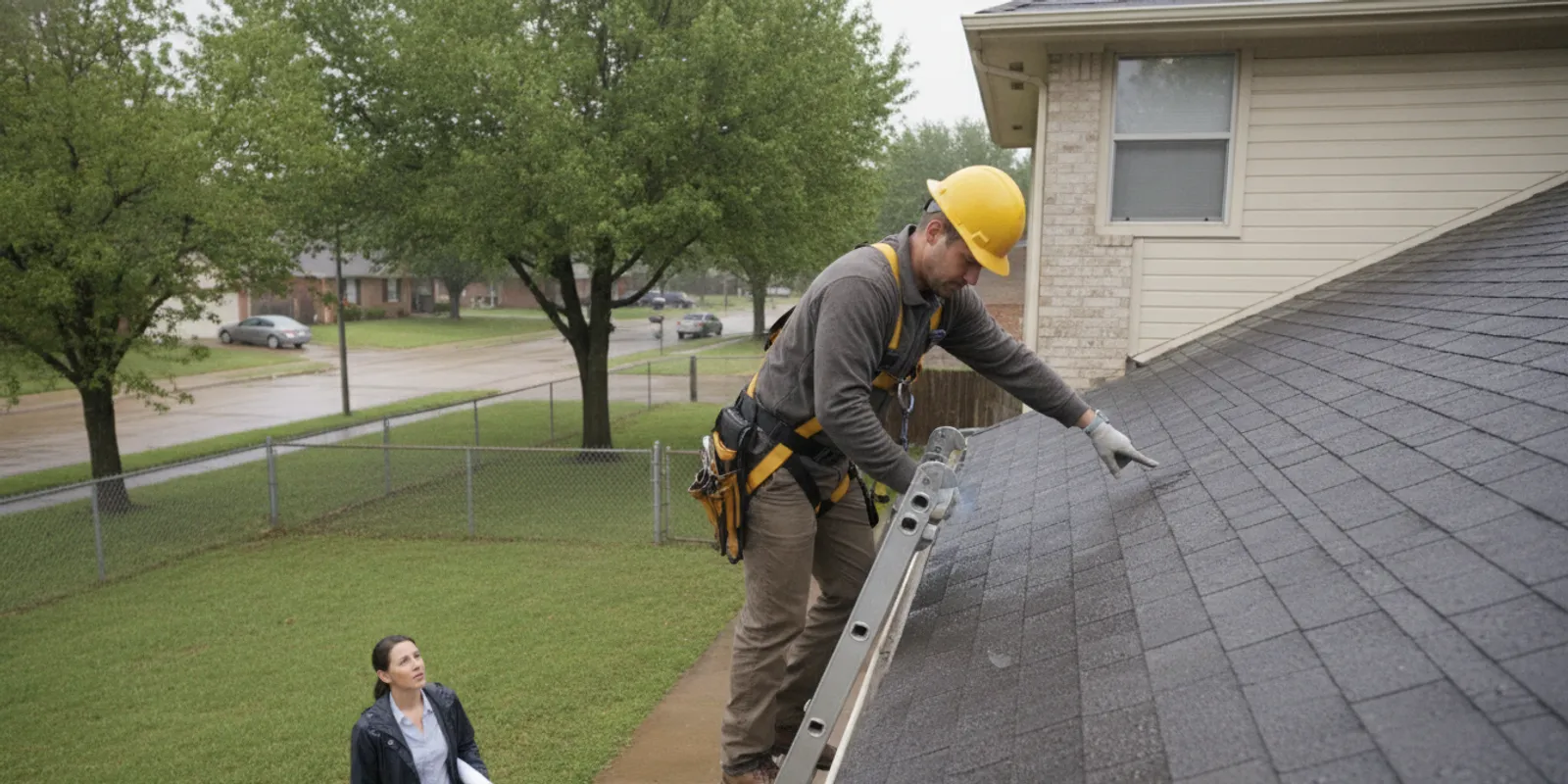
After a storm, a ground-level view may reveal an obvious concern, but it cannot rule out damage. Do not climb a wet or unfamiliar roof to check a report. A qualified roofer can assess the roof using suitable access and explain the observed condition. When arranging an inspection, give the professional the tenant’s report, affected location, weather context if known, and relevant repair history. That information is more useful than an unverified diagnosis.
How can landlords reduce repeat roof problems?
Keep a maintenance history for each property and make it easy to see unresolved issues. Record roof age only when known and documented; do not use an estimate as a confirmed fact. Keep dates and descriptions for prior repairs, recurring leak locations, inspections, and any follow-up recommendations. This history gives a professional context and helps the owner notice patterns that might be missed if each tenant report is handled as an isolated event.
A routine review of the property file can identify open items: an inspection that recommended a follow-up, a repair awaiting approval, or an earlier leak without a tenant check afterward. After severe weather, tenants can be reminded how to report new water intrusion, but should not be asked to inspect the roof. Owners or managers may look for obvious signs from a safe ground-level vantage point, while recognizing that a visual check from below cannot establish the condition of the entire roof.
When work is completed, retain the scope, invoice, and any photos or closeout notes. Ask the contractor what maintenance or follow-up is recommended for the specific roof, and write down the response. Review the actual written agreement for any warranty terms; a general statement about a warranty is not a substitute for its conditions and exclusions. If the tenant reports that water has returned, connect that report to the earlier job and request an appropriate review rather than assuming the previous repair either succeeded or failed without checking.
A simple seasonal file review can be useful even when no leak is active. Confirm that occupants know where to report a concern, that contact information is current, that access instructions are recorded, and that an authorized person can approve an inspection. For a property with several units, organize reports by unit and room. Repeated reports in one location may call for follow-up on that repair; reports in different locations may provide context for a wider evaluation. These are prompts to investigate, not conclusions about the roof.
Preventive attention can help landlords find maintenance needs before an interior symptom becomes more disruptive, but no routine eliminates every roof issue. The practical aim is not to promise a leak-free building. It is to keep records usable, respond to reports, and seek an assessment when facts suggest that work may be needed.
How should multi-unit and commercial properties be managed?
Multi-unit buildings require careful coordination because one roof can affect separate apartments, corridors, and shared areas. Record each tenant’s report individually and note the unit, room, and time. If multiple reports arrive, keep their relationship visible without merging them into one vague ticket. Ask whether the symptoms began at the same time and whether anyone has noticed water in a common area. This helps the assessor understand the pattern while preserving each occupant’s account.
Identify who may grant access to each unit and who can approve roof work. Share access requirements with tenants in a clear way and follow the lease and applicable legal requirements for entry and notice. Do not assume a roofer can enter a unit or common area merely because the property owner authorized an exterior inspection. If access is restricted, tell the professional before the visit and ask what can be assessed without it. A manager should avoid promising that a particular unit will need no further access until the assessment establishes that.
Commercial properties may have operating hours, rooftop equipment, controlled access, or tenant activities that shape the work plan. Tell the assessor about restricted areas, equipment, access procedures, and any building operations that could be affected. State whether the request concerns active water intrusion, post-storm observations, a recurring issue, or planned maintenance. The property owner or manager remains responsible for decisions about building access, tenant communication, and work authorization.
For any property type, set a single point of contact for the incident and a clear method for forwarding new observations. The tenant or commercial occupant can report what they see; the owner or manager can decide how to coordinate the response; and the professional can evaluate the roof within the agreed scope. Keeping these roles clear helps prevent a maintenance worker or tenant from receiving conflicting instructions about diagnosis, access, or repairs.
After work, do not close the incident solely because the contractor left the site. Confirm that the owner received the work record and that the tenant knows how to report any continuing or returning symptom. For a building with several affected units, follow up with each relevant occupant instead of assuming that one response represents everyone. Update the common maintenance log with the completed scope and any open recommendations.
What is a practical landlord response workflow?
A written workflow turns broad responsibilities into repeatable actions. It should be simple enough for staff to use under pressure and flexible enough to account for urgent conditions. The following sequence is a starting framework, not a substitute for legal requirements, lease terms, insurer instructions, or professional advice.
- Receive and record. Capture the reporter, date, location, symptom, and current status. Save the original message rather than relying on a later summary.
- Screen for safety. Ask about water near electricity, a sagging ceiling, active dripping, and access hazards. Give immediate safety direction when appropriate.
- Protect without creating new risk. Suggest only simple actions that are safe for the occupant, such as moving belongings away from a drip. Do not send an unprepared person onto the roof.
- Arrange the right assessment. Provide the full set of observations and relevant history to a qualified professional. Confirm who will coordinate access and who may authorize the proposed work.
- Review findings and scope. Ask what is observed, what remains uncertain, what work is included, and what is excluded. Document the decision and any unresolved questions.
- Communicate confirmed details. Tell the tenant what is planned, what access is needed, and how to report a change. Avoid unsupported statements about cause or timing.
- Keep the record and follow up. Save work documentation and ask whether the symptom recurs. Reopen or extend the incident record if new information arrives.
Assign roles in advance when more than one person manages the building. One staff member might receive reports; another may coordinate access; an owner or property manager may approve scope; and a bookkeeper may retain invoices. The exact arrangement depends on the property, but the tenant should not have to guess who owns the next action. Keep the workflow current if contact details or approval authority changes.
Use a short checklist rather than an elaborate form that staff will skip. At minimum, the record should capture the report, safety screen, inspection status, authorized scope, tenant update, and follow-up result. A manager can add fields for units, prior incidents, insurer communications, or access instructions where they are useful. The goal is a dependable record, not a perfect database.
Review the process after a difficult incident. Did the report reach the right person? Did anyone make an unsupported promise? Were access details missing? Did the written scope match what the tenant observed? Improvements to the process can reduce confusion next time without assuming that every leak follows the same pattern.
What mistakes can make a roof issue harder to resolve?
Some common missteps create confusion or delay a reliable assessment. First, do not dismiss a report because the visible stain is small or old. Ask when it changed and whether it recurs, then document the answer. Second, do not treat a tenant’s description as a technical diagnosis. Preserve the description accurately and let a qualified professional assess the roof. Third, do not send a resident or unprepared employee onto a roof to take photos. The information is not worth creating a fall or electrical hazard.
Another mistake is promising an arrival, completion date, or repair result before those details are confirmed. Acknowledge the issue, state the next action, and update the tenant when a provider confirms practical details. Avoid promising that a repair will prevent all future leaks; the scope and conditions matter, and only the written terms establish any applicable assurance. Honest uncertainty is more useful than a confident statement that later proves inaccurate.
Do not patch an interior surface and assume that the roof source has been resolved. A ceiling repair may improve appearance but does not, by itself, identify or correct a roof opening. Likewise, do not authorize a broad project based only on a tenant’s stain or a ground-level glance. Make decisions from the assessment and clear scope, and ask questions if the findings do not explain how the recommended work relates to the reported symptom.
Do not combine an insurance question with the technical diagnosis. A contractor’s report may support a discussion of observed conditions, but the insurer decides coverage under the policy. Do not tell a tenant that a claim will pay for their belongings, and do not delay appropriate safety measures while waiting for a claim decision. Keep the factual record and get the relevant policy or legal questions to the appropriate professional.
Finally, do not close the loop only with the contractor. The tenant is the person who may notice a returning leak inside the unit. Ask for a follow-up report and keep that response with the original incident. A repair record without a post-work check leaves an important piece of the property’s history unknown.
How do common rental roof scenarios change the response?
The response should fit the facts that are known. A consistent process does not mean every report receives the same action; it means the landlord asks the same core questions, records the answers, and responds to the level of risk. The examples below show how to use the process without treating a hypothetical as a rule for every building.
Scenario: a ceiling stain appears after a storm but feels dry
The tenant sends a photograph of a small, dry mark and says it appeared after overnight rain. There is no active drip, no water near electrical equipment, and no change since the tenant first noticed it. The landlord should acknowledge the report, record the date and location, and ask whether the mark has appeared before or is growing. If the photo can be taken safely from the floor, keep it in the incident record. Arrange an appropriate assessment based on the circumstances and provide an update when the next step is confirmed. Do not tell the tenant that a dry stain proves the roof is fine, or that it proves a current roof failure. A professional can evaluate the symptom and its likely source.
If the assessment finds no active roof defect, preserve that finding and any recommendation for monitoring or follow-up. Ask the tenant to report a change, such as new dampness or expansion, and explain how to send that update. The landlord should avoid asking the tenant to scrape paint, open a ceiling, or inspect insulation. If the stain changes, record the new observation and provide the earlier report to the professional so the change can be considered in context.
Scenario: water is actively entering near a light fixture
Here, safety comes before routine scheduling. The landlord should promptly tell occupants to avoid the affected area and not to touch the fixture or wet electrical equipment. If there appears to be an immediate danger, seek appropriate emergency help. Record what the tenant reported and when, then contact a qualified professional to assess the building and determine what safe next steps are available. Do not ask the tenant to remove a fixture, climb a ladder, or catch water in a way that requires standing under a bulging ceiling.
The update to the tenant should be concise and factual: confirm receipt, state the safety precaution, and explain that an assessment is being arranged. If access to the unit is needed, coordinate it in accordance with the lease and applicable requirements. Once a professional has assessed the issue, share the next steps and any practical access needs. Do not promise that the electrical concern is resolved until an appropriate person has evaluated it.
Scenario: the same unit reports another leak after a repair
A returning symptom deserves a new record connected to the prior work. Ask whether it is in the same room and exact location, whether water is active, when it returned, and whether the tenant has noticed a change in the stain or surrounding area. Save the new photo and message, then locate the prior inspection findings, approved scope, and closeout notes. Share those materials with the professional who will review the condition. This makes it possible to compare what was reported before, what work was performed, and what is being observed now.
A recurring report does not, by itself, establish that the earlier work was defective. The symptom could have a different source, a condition may have been concealed, or the earlier scope may have addressed only part of the issue. Nor should the landlord dismiss the report because the prior invoice is marked complete. Record the current facts, ask for an assessment, and rely on the written agreement for any questions about applicable repair terms.
Scenario: separate units report stains in different rooms
In a multi-unit building, collect each report separately and then look for possible patterns. Record the unit, room, report time, whether the condition is active, and any reported weather connection. Give the professional a simple location list or floor plan, along with relevant repair history. Do not assume a common roof means every stain has one cause, and do not assume separate locations are unrelated. A professional can assess whether a broader review is useful. Meanwhile, communicate individually with each occupant, address any safety concern, and keep the shared areas in the incident record.
How can landlords prepare for an inspection and close out the work?
Good preparation helps the assessor focus on the reported condition and reduces avoidable back-and-forth. Before the visit, gather the tenant’s original message, safe photos, dates, prior repair records, and any details about access. Identify the rooms or units involved, and note whether water is still entering. Tell the professional about attic restrictions, pets, locked gates, rooftop equipment, or other practical conditions that could affect access. Do not conceal uncertainty: if the start date or cause is unknown, say so.
At the assessment, the owner or manager can ask the professional to explain the observed condition, the relationship between the interior symptom and any roof finding, and the limits of the inspection. If the report recommends immediate temporary protection followed by later work, record both steps and who is responsible for coordinating each one. If a decision cannot be made until more information is available, identify exactly what information is missing and what action will obtain it. This keeps “we are still looking into it” from becoming an open-ended status with no owner.
Before authorizing a proposal, verify that the description matches the property and location, that included and excluded work are clear, and that a process exists for documenting unexpected conditions. Make sure the person approving the work has authority to do so. If the tenant must move belongings or provide access, communicate only details that are confirmed. Keep any revised scope with the original proposal rather than replacing the record with a final invoice alone.
After work, obtain the closeout documents promised in the scope, such as an invoice, written summary, or photos, and store them with the incident. Ask the tenant whether the reported symptom continued or returned; record the answer, including when there was no further report as of the check-in. If a follow-up inspection or maintenance step remains open, assign it to a named property contact and note when it should be reviewed without promising an unconfirmed service date. Close the incident only when the owner has a usable record of what was observed, what work was authorized and completed, and what remains unresolved.
Frequently asked questions
Does a tenant have to repair a roof leak?
A tenant should report a leak promptly and avoid unsafe actions. Who is responsible for a particular repair or cost depends on the lease, facts, and applicable law. Roof-level work generally calls for suitable access and coordination; a tenant should not be asked to climb onto a roof to investigate. For a specific dispute, consult a qualified Oklahoma attorney or tenant resource.
Should a landlord wait until the rain stops before contacting a roofer?
A landlord can contact a roofing professional as soon as a concern is reported and ask what assessment or safe temporary measures are appropriate under current conditions. Some work may require suitable weather or access, but an active leak or safety concern should not be ignored while waiting. Follow the professional’s guidance and keep the tenant informed about confirmed next steps.
Can an inspection prove that insurance must pay?
No. An inspection can document observed conditions, but it does not decide coverage. The insurer applies the policy to the claim. Photos and a written report may help explain what was observed, but do not guarantee approval or a specific payment.
What information should a landlord give the roofer?
Share when the issue was reported, where it appears inside, whether water is still entering, any safely taken photos, prior repair history, and relevant access restrictions. Mention recent weather if known, but distinguish that context from a confirmed cause. For multi-unit properties, identify each affected unit and area.
How can a landlord tell whether a repair worked?
Keep the work record and ask the tenant whether the reported symptom has returned. A dry period alone may not settle every question, and a later report should be documented and assessed in context. If the issue recurs, share the original findings and scope with a qualified professional so the next review can consider what was previously done.
Review roof repair and replacement considerations
When a rental roof concern is handled with a clear record, safe assessment, honest updates, and follow-up, landlords have a stronger basis for deciding what to do next. Keep tenants informed, preserve the relevant documents, and seek legal or insurance guidance when the situation calls for it.